
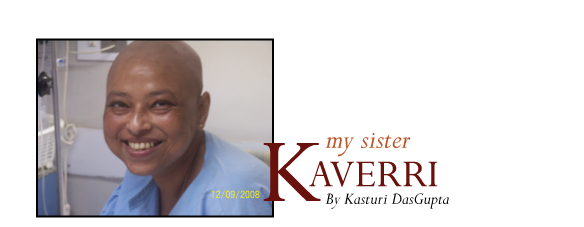
On Thursday, July 23rd 2009, at 5:54am – exactly a year after she was diagnosed with esophageal cancer, my sister Kaverri breathed her last at the Nazareth Hospital in Shillong. No stone had been left unturned to find a cure, but ultimately all was lost to this unforgiving affliction. She was taken before her time; snatched away at the prime of her life; so much of what she wanted to do so passionately, now remains undone. Her sufferings were unspeakable – the pain immeasurable. Yet, she endured it all with such courage, fortitude and stoic patience - never ever feeling sorry for herself. Up until the very end she was more concerned about the welfare of others rather than her own. And all through she kept hoping that there would be time to finish her book on our parents; that there would be time to finalize the details for the journalism award that she had put together in our parents name. But the disease raged through her like a wildfire destroying all the vital organs; she didn’t have a chance.
She was a rare human being – God created a unique mold when he (she) made her. She was at once childlike in her simplicity, her unbounded joyfulness touching everyone – especially the young – but also earnest and resolute as she pursued her activities with utmost seriousness. She was shaped by the values of patriotism, humanitarianism, egalitarianism – a champion for the underprivileged, the destitute and the downtrodden. Nobody who came to her for any assistance was ever turned away. Her convictions were clear and unambiguous. A perfectionist, she inspired others to rise to be their very best. A catalyst, she took the organizations she worked with to unprecedented levels of success.
Kaverri (Kumkum) Gupta was born on May 2nd 1957 in Shillong, the younger of two sisters. Our parents Hemanta Kumar Gupta and Kalpana Gupta were freedom fighters as well as renowned and pioneering journalists. In Shillong, Kaverri studied at Pinemount, Auxilium, Loreto and Jail Road Girls Schools. She received her undergraduate degree in English and History from Arya Bidyapith College in Guwahati and her M.A in English literature from Guwahati University. She loved English literature and was profoundly influenced by the works of many. Her grasp of Indian history always astonished me, especially the excitement she had in narrating the events from eras past which determined how our country and its people would turn out to be. She was unforgiving of herself when she could not remember a date or event. On our way to Solan in June, where she was going for Ayurvedic Treatment, we crossed Panipat. She talked about the three battles that were fought there, but when she couldn’t remember who fought the third battle she was mortified, and called up our cousin Kamal to check that information in Google for her immediately. By this time in June she was in terrible pain, having trouble swallowing food or water – but she was more interested in checking out the places we passed on our way for historical significance than dwell on her own travails!
She was a banker by profession; she joined the State Bank of India in 1978 and remained a stellar employee of the institution for almost thirty years. Under her leadership many State Bank branches enjoyed unprecedented success. As a SBI employee her primary objective was to serve the public. She took her role in the bank as a way to provide individuals and communities, with as little delay and red tape as possible; the financial resources they needed to survive, to start businesses, to build homes. Organizations that minister to the poor and are dedicated to community service have related many anecdotes of how she would circumvent the bureaucracy of the bank to make sure that they received donations, and big ones at that. She almost single handedly initiated and completed the process to ensure that state employees could have their salaries deposited to the bank directly. But in 2006, when it became clear to her that she would be transferred away from Shillong and that all her entreaties – that she wouldn’t, she couldn’t move our mother away from Shillong without endangering her health; that she couldn’t leave our mother behind, who she had cared for as long as anyone could remember - were falling on deaf ears, she decided to take voluntary retirement, even though she had many years of service still left ahead of her. Her devotion to our mother was exemplary – her friends remember how, regardless of what she was doing, she would rush home to give mother her insulin injection, to prepare her meals – to make sure she wasn’t too lonely.
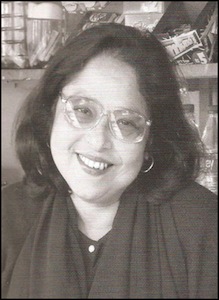 Her dedication to public service provided the impetus for her work in various community organizations – the Rotary Club of Orchid City, Kench’s Trace Puja Committee, The Central Puja Committee, Bharat Scouts and Guides, Chaturanga. Kaverri was well loved and respected by members of all the different communities of Shillong for her selflessness and dedication to community service. Numerous people have recollections of the different ways in which Kaverri made a difference in their lives. She had a list of donors made up according to their blood group so when ever anyone needed blood my sister would be there calling up people, even in the middle of the night, to summon their help. Women in abusive relationships would come to her and she would put them in touch with lawyers and doctors. When a national table tennis tournament had to be arranged in Shillong, they came to Kaverri for ideas – and she gave them much more than that. After India’s last war with Pakistan – she arranged for a memorial procession for the young man from Shillong who had died in the war and collected record donations for his family. When communities faced violence and threat because of ethnic strife or floods – she would be in the forefront organizing help and support. The Scouts and Guides who depended on her for innovative ideas for fund raisers bemoaned her absence and all that she had meant to them. After the premature death of Ardhendu Choudhury in a helicopter accident, Kaverri organized an unprecedented ceremony to acknowledge the assistance and support of the local residents of the small island into which the wreckage of the plane and the bodies of the dead had fallen. Every year during Durga Puja she would organize buses to take the children from Bethany to participate in the festivities all around Shillong – going from one Puja pandal to the other with a convoy of buses with their cargo of very special young people following her car. Along with the Rotary Club of Orchid City, Kaverri played a critical role in organizing the open heart surgery which gave a young child named Priya a new lease on life – the list can go on and on.
The Rotary Club of Orchid city, Shillong was her life – she took to heart the motto of the Club – Service above Self and made her life a model for it. She was the matriarch of the club. She was the President of the Rotary Club of Orchid City in the 2005-2006 calendar year and many have remarked that that was the year when the club was the most productive. Members and their spouses came to the meetings in record numbers, participating in the numerous projects that she initiated and inspired. It seemed to her fellow Rotarians that she never slept – they would get reminders, greetings and updates from her in the middle of the night! During her tenure she put together a Club Directory which was a labour of love and showed her competency at the computer. The Directory was a wealth of information – comprehensive and all inclusive – it had pages dedicated to the history and purpose of Rotary, list of meeting dates and events, birthdays and anniversaries of the members and a remarkable list of officers and members with their contact information and likenesses printed in silhouette, which showed her tremendous dexterity with the cutting edge image making technology. I never stopped being absolutely amazed by all that she could do on the computer – by all that she had taught herself.
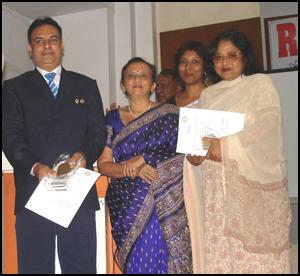 She was selected as one of the most effective presidents – the best president in the Rotary district for that year - and during her tenure not only did members attend in record numbers – they did literally hundreds of projects which touched the lives of so many in Shillong and its vicinity – clean water projects, health camps, vocational training, environment protection, literacy projects, blood grouping and donations projects, youth service and career counseling, poverty alleviation projects and many more.
In the first week of July 2009, on our way to Delhi from Solan, we were in Haridwar, where we had gone on my sister’s insistence. She was going to offer funeral rites for our mother, who had died less than a year and a half ago. Things were already very difficult – she was wreaked with pain all over, she was hardly able to eat, a little bit of soup was all that sustained her. Fearing the heat wave that was making life impossible for people in Delhi and Haridwar, I pleaded with her to drop the idea. But she would not relent and after a few altercations I gave in, as I always did. In Haridwar we stayed at a hotel which gave a clear view of the Ganges, at any other time I know she would have been entranced by it – but now she could care less. I chose a special room where the breeze from the river could blow in unobstructed – soothing and refreshing. But all she wanted to do was sleep – I can see her in my mind’s eye resting on her side of the bed, rising only to go to the bathroom or to sit up and retch painfully, trying to bring up the phlegm which would collect in her throat. But that did not stop her from attending to Rotary business – on those first days of July she sent text messages congratulating the new President and District Governor offering her services, yet again, notwithstanding the circumstances, for sending out the greetings for birthdays and anniversaries to the district members. She realized that she did not have the roster with her from which she could call up members with forthcoming birthdays and anniversaries. So she called up our cousin Kamal, again, to see if he could retrieve the information from her PC. I was astounded at her strength of mind, her dedication to Rotary and her undying desire to offer her services even when all her own strength was slowly ebbing. Recalling those days and how she struggled fills me up with untold sadness, but then I was frustrated, all I wanted her to do was put her mind to getting well and nothing else. Her obsession with Rotary at such a critical juncture in her life annoyed me. But hadn’t I taken her to the district meeting in Guwahati on May 3rd, 2009 – the day after her last birthday, even though she woke up with a 104 degree temperature? Hadn’t I taken her to the Rotary Meeting one Wednesday evening in Solan, even though she had remained listless with pain all day, even though she hadn’t eaten a bite all day? I had taken her against all odds because Rotary and its activities gave her energy and a purpose – in the middle of everything that was so hopeless and negative, the Rotary revived her, even if for a little while, it gave her hope and filled her up with positive energy – she relished the company of her fellow Rotarians, to whom she was dedicated till the end of her life. On July 18th she had sat up for a little while to try and take a few sips of the blackberry juice, which she developed such a taste for at the end of her life, when one of the Rotary members came to see her. “How is Banlumlang doing as the new President and how about Priam as the new secretary?” she enquired assessing the health of the Rotary under its new leadership, just like a mother hen, making sure all was well. She had been almost comatose the day before but now rose like the phoenix to survey the terrain to my utter amazement and relief – and it was the Rotary which had brought her out of her stupor!
She embodied the spirit of the Rotary international. If she lived she would have become a renowned Rotarian inspiring others to do their very best. After she was gone so many of her fellow Rotarians pledged that they would continue to draw inspiration from her life and her love of Rotary and that would encourage them to be the kind of Rotarian, my sister so naturally was.
With her nothing was ever about herself. It was always ‘service above self’ - embodying it in her life through all she did for her beloved Shillong and all its inhabitants. She knew no distinction of class, religion, tribe or caste. She sought everyone out as if they were her most near and dear ones. Shillong has known the divisiveness and tragedy of ethnic strife – but for Kaverri every community not only opened their doors but embraced her as one of their own. After she died hundreds from every community of Shillong came to pay their respects and mourned like they had lost one of their own.
And one didn’t have to be a human to partake in the gifts of her generous spirit – she picked up a stray puppy one day in the winter of 1983 and it has ever since been referred to as my nephew, Bozi; as have been other nieces and nephews among our feline relatives. She spared no one her wrath if she knew that they had ill treated an animal. When our house was infested with rats in May of this year she refused to poison them fearing that they would struggle for breath just as she had when she was struck down with pneumonia. She indulged her pets as much as she indulged the children in her life – her nieces and nephews, the children of neighbours and friends. She would always have sweets and snacks ready for them and they in turn were devoted to her and to all that she stood for.
She was an artist of tremendous gifts. My daughter recalls of the time in 1992 when Kaverri came to the United States for a short visit and showed her flair to draw beautiful pictures on the computer screen by maneuvering the mouse – this was at least a decade before a mouse stylus had even been invented. Her alponas stood out in their simple beauty and uniqueness adorning floors on festive occasions and weddings. She won prizes and accolades for baking cakes which looked like the Taj Mahal or the wheel from the Konarak temples or in the shape of tanks to memorialize the martyrs of Kargil.
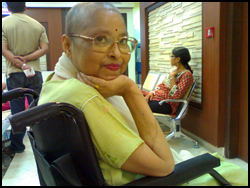 She sang beautifully and it seemed to me that as cancer sapped her energy at every other level it opened up her vocal chords so she sang more beautifully than ever before, so no road trip would be complete with out singing of songs to which she would forcibly include me even when with the reality of her sickness and her sufferings on my mind I had no desire to be singing! But she was un-deterred. It was only on the last two road trips – from Solan to New Delhi and then the trip from Guwahati to Shillong, just two weeks before she died, that the disease silenced her.
The tragedy of a life left incomplete is so wrenchingly painful - the cliché ‘the good die young’ an awfully poor consolation. There was so much she could still accomplish; so many lives she could still touch; so many injustices she could still have fought, so much laughter and joy that she could fill up our lives with – how devastatingly premature her demise! What goes through the mind of a person facing such an eventuality? My heart is inconsolable when I imagine the thoughts which must have ravaged my sister’s mind as death stared her in the face.
I have to finish the book she started on our parents – she was so excited about writing it and spent all the time after our mother passed away in October 2007 to do research, travel to Bangladesh to see for herself our ancestral village, to see for herself the places where our father inspired by Gandhi’s message of non-violence and self determination had organized movements against the British; the street where he had been beaten and left for dead by the British police force – she did all that in the 8 months after our mother left and I wonder if she had disregarded the first signs of the dreaded disease and only went to the doctor in June/July 2008 when she couldn’t eat anymore and when it was already too late? And I think even in the middle of the hopelessness for any real cure she somehow believed that she would have the time to finish her book.
And now it is left to me to finish all that is unfinished – for there were four and now there is one – just one, one left to tell the story.